The complete NEXTuino range — eleven controllers spanning four families, all running the Arduino ecosystem on proven industrial hardware. CE certified, DIN-rail mounted, and built for the real world.
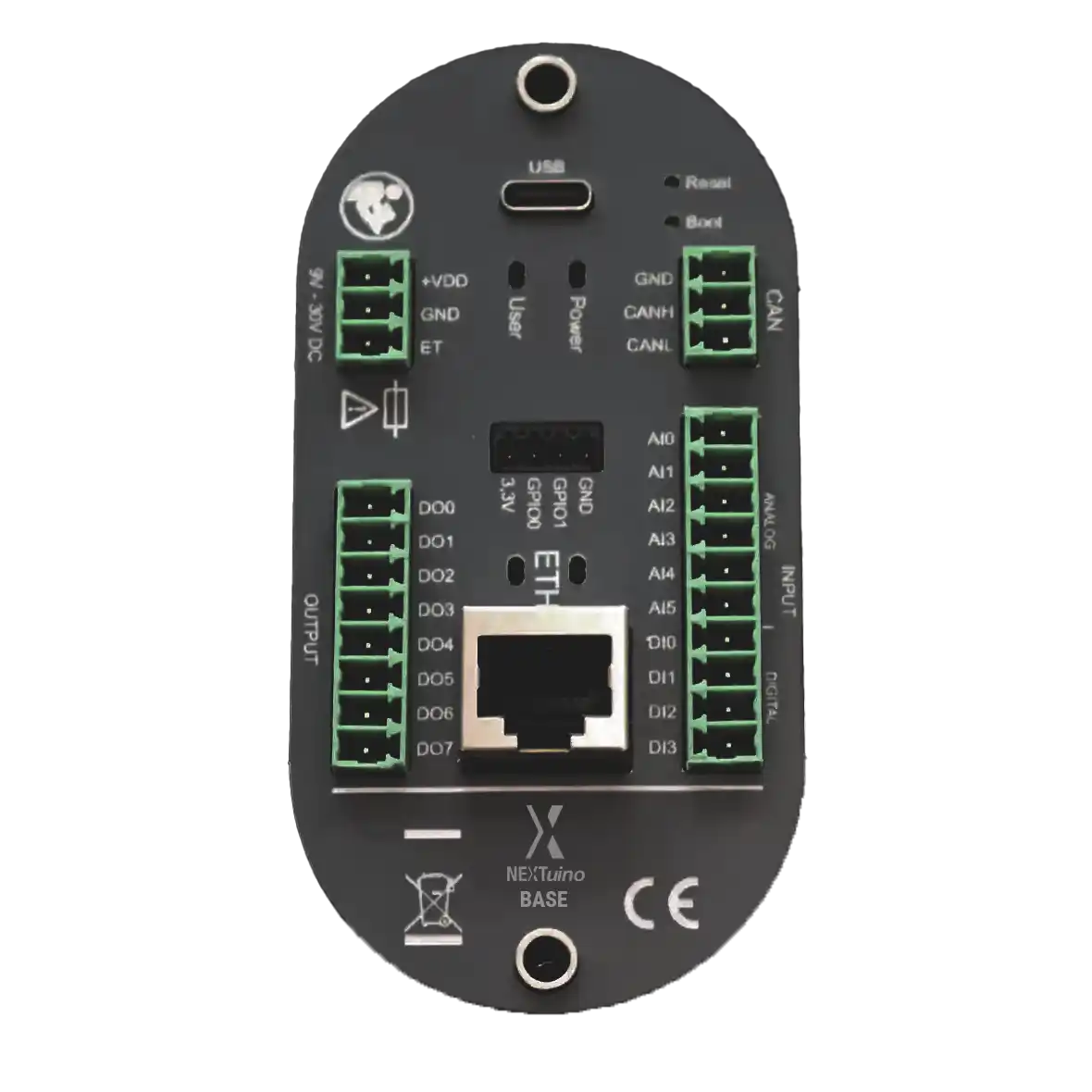
One model. RP2040 dual-core, 24-bit analog inputs, Ethernet, CAN/RS-485 and USB-C — everything you need to start automating in the most compact form factor of the range.
Built on the RP2040 dual-core ARM processor with six 24-bit sigma-delta analog inputs — an analog resolution you won't find in any comparable entry-level controller. Ultra-compact 100 × 50 mm DIN-rail module, ready for production environments from day one.
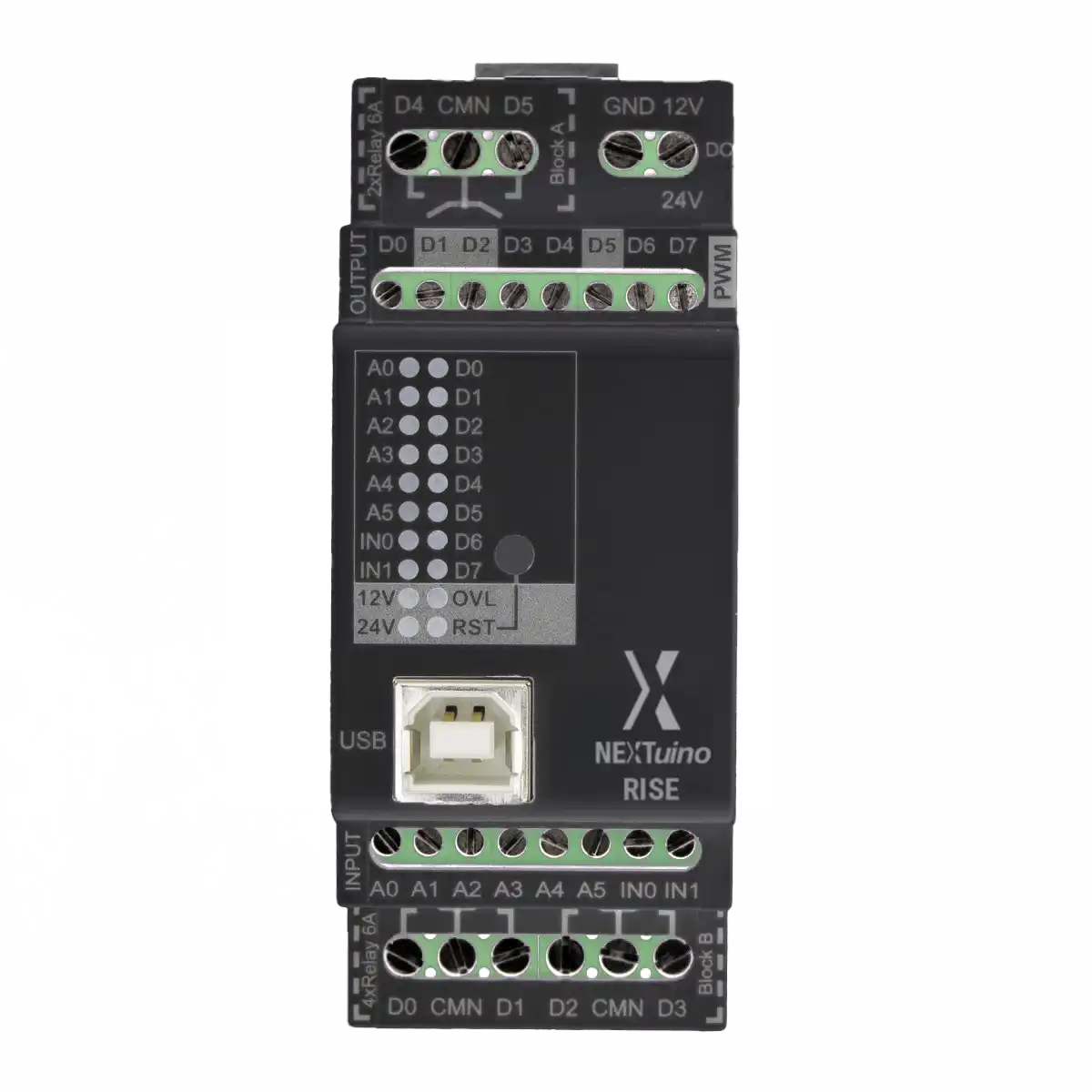
Two variants sharing the same ATmega328 core and full relay I/O — choose the RISE for prototyping and shield expansion, or the RISE CORE for streamlined OEM production builds.
NEXTuino RISE
8 protected digital inputs, 8 transistor outputs and 6 relay outputs (10 A / 240 V AC) with full Arduino Uno pin headers. The ideal controller for mid-range machine automation and rapid development.
NEXTuino RISE CORE
Identical I/O and firmware to the RISE — without Arduino pin headers. More compact, lower BOM cost, and production-ready for volume OEM deployments where shield expansion isn't needed.
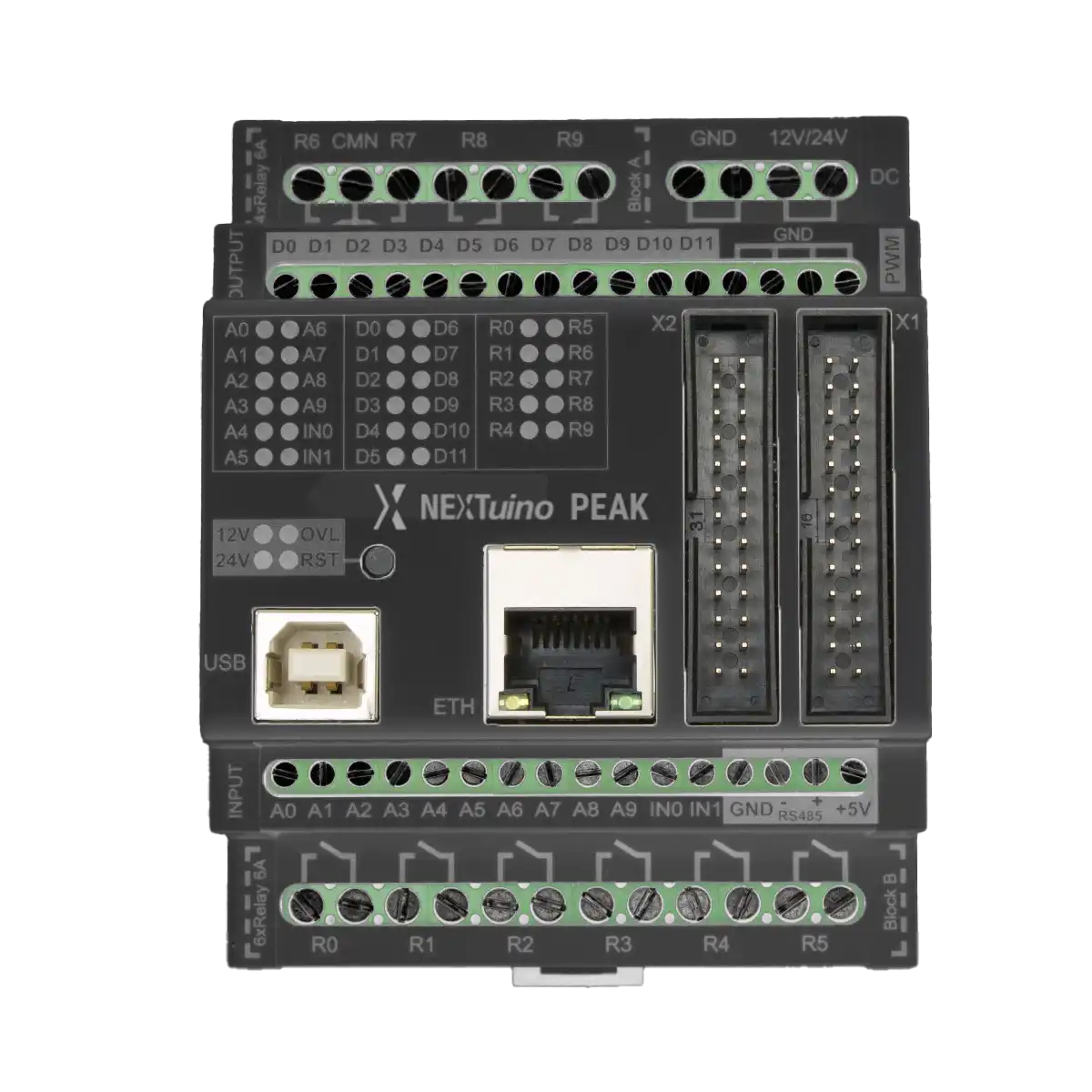
The PEAK family is built on ATmega2560 — the same processor as the Arduino Mega 2560 — and spans six models covering every combination of I/O count, analog channels, relay current rating and form factor.
The foundation of the family. 12 digital inputs, 12 transistor outputs, 10 relay outputs, RS-485 Modbus RTU and Ethernet — all in a single DIN-rail module. Works on both 12 V and 24 V DC. Full Arduino Mega 2560 pin headers for shield expansion.
NEXTuino PEAK CORE
Full PEAK I/O — 12 DI, 12 DO, 10 relays, RS-485 and Ethernet — in a compact headerless module. The preferred option for OEM volume panel builds.
NEXTuino PEAK FLEX
18 digital inputs, 0–10 V analog I/O and Ethernet. Designed for 24 V automation systems that need mixed digital and analogue control in a single module.
NEXTuino PEAK FLEX CORE
All the FLEX analog I/O in a compact, headerless module. 18 DI, 0–10 V analog channels and Ethernet — optimised for OEM builds at 24 V DC.
NEXTuino PEAK PLUS
PEAK processing with 5 high-current power relay outputs rated to 16 A / 240 V AC. RS-485 Modbus RTU and Ethernet included. For motor starters and heavy industrial loads.
NEXTuino PEAK PLUS FLEX
The most versatile PEAK variant. 18 digital inputs, 0–10 V analog I/O and 5 power relay outputs (16 A) — analogue control and heavy load switching in one unit.
⚙️
Not sure which PEAK?
Each variant targets a specific use case. Our team can match the right model to your I/O list and supply voltage.
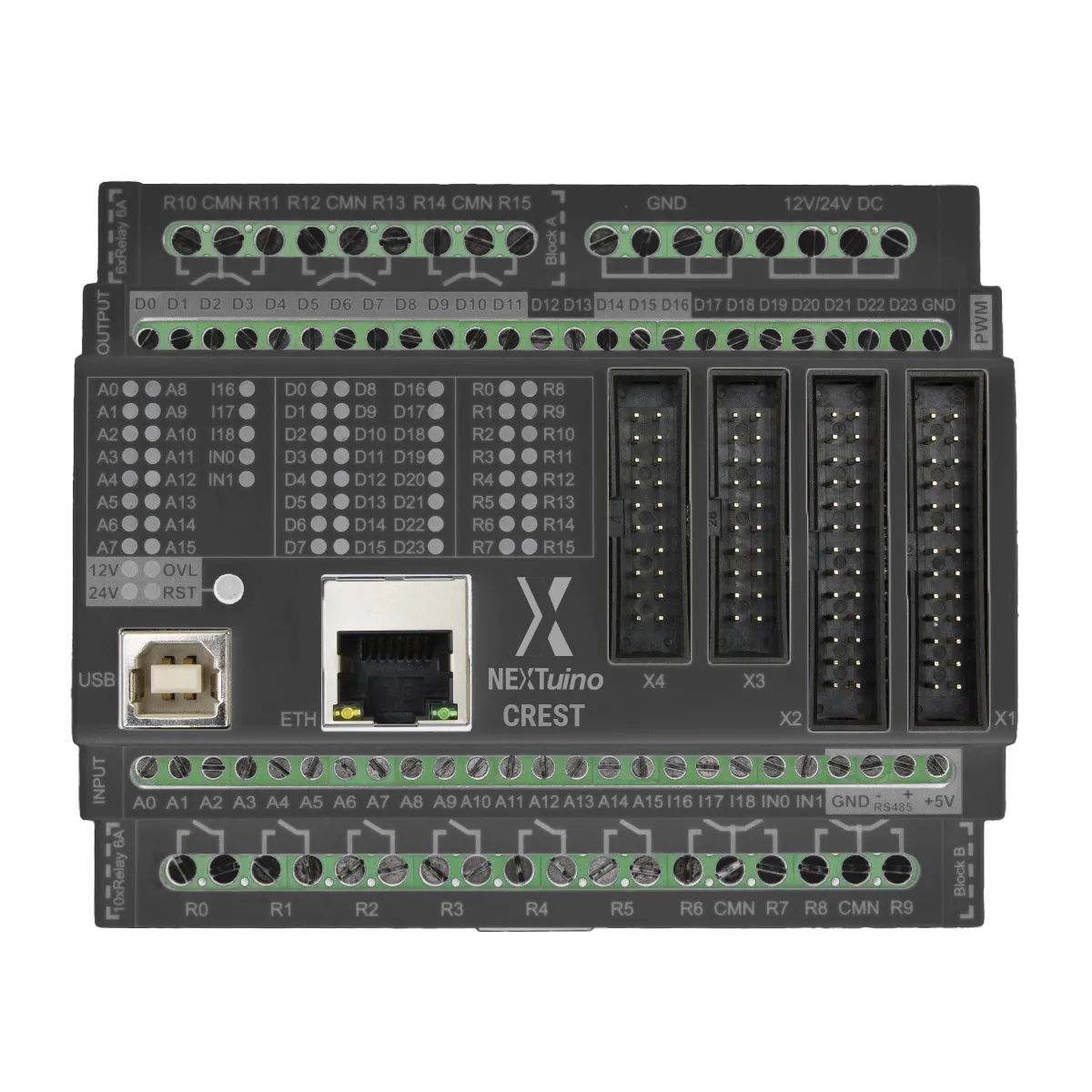
Talk to an EngineerWhen the application demands more — 21 digital inputs, 24 digital outputs, 16 relay outputs — the CREST delivers it in a single DIN-rail controller. No external expansion modules. No extra complexity.
NEXTuino CREST
The highest I/O count in the NEXTuino range. 21 protected digital inputs, 24 transistor outputs and 16 relay outputs — with RS-485 Modbus RTU and Ethernet. Full Arduino Mega 2560 headers for shield and expansion use.
NEXTuino CREST CORE
All the I/O and connectivity of the CREST — 21 DI, 24 DO, 16 relays, RS-485 and Ethernet — in a headerless module optimised for volume OEM panel builds where every millimetre counts.
Every NEXTuino controller is fully Arduino compatible — Arduino IDE, PlatformIO, Visual Studio Code. The same libraries, the same workflow, the same community. Industrial hardware that doesn't demand a new learning curve.
NEXTuino is built on an open source based software ecosystem. Your firmware belongs to you — readable, portable and maintainable long after a project ships. The NEXTuino Arduino library is open and available on GitHub.
Engineers looking for a Controlino alternative consistently choose NEXTuino for its broader product family, from the compact BASE to the high-I/O CREST, and for its more open hardware approach — especially in OEM volume applications.
Tell us about your project and we'll help you pick the right controller. Or jump straight into the documentation and start building.