All the I/O and connectivity of the CREST — without the Arduino headers.
The NEXTuino CREST CORE delivers the same 21 digital inputs, 24 digital outputs, 16 relay outputs, RS-485 Modbus RTU and Ethernet on the ATmega2560 platform — without Arduino pin headers. Designed for OEM machine builders who need maximum I/O in a compact, cost-efficient form factor.
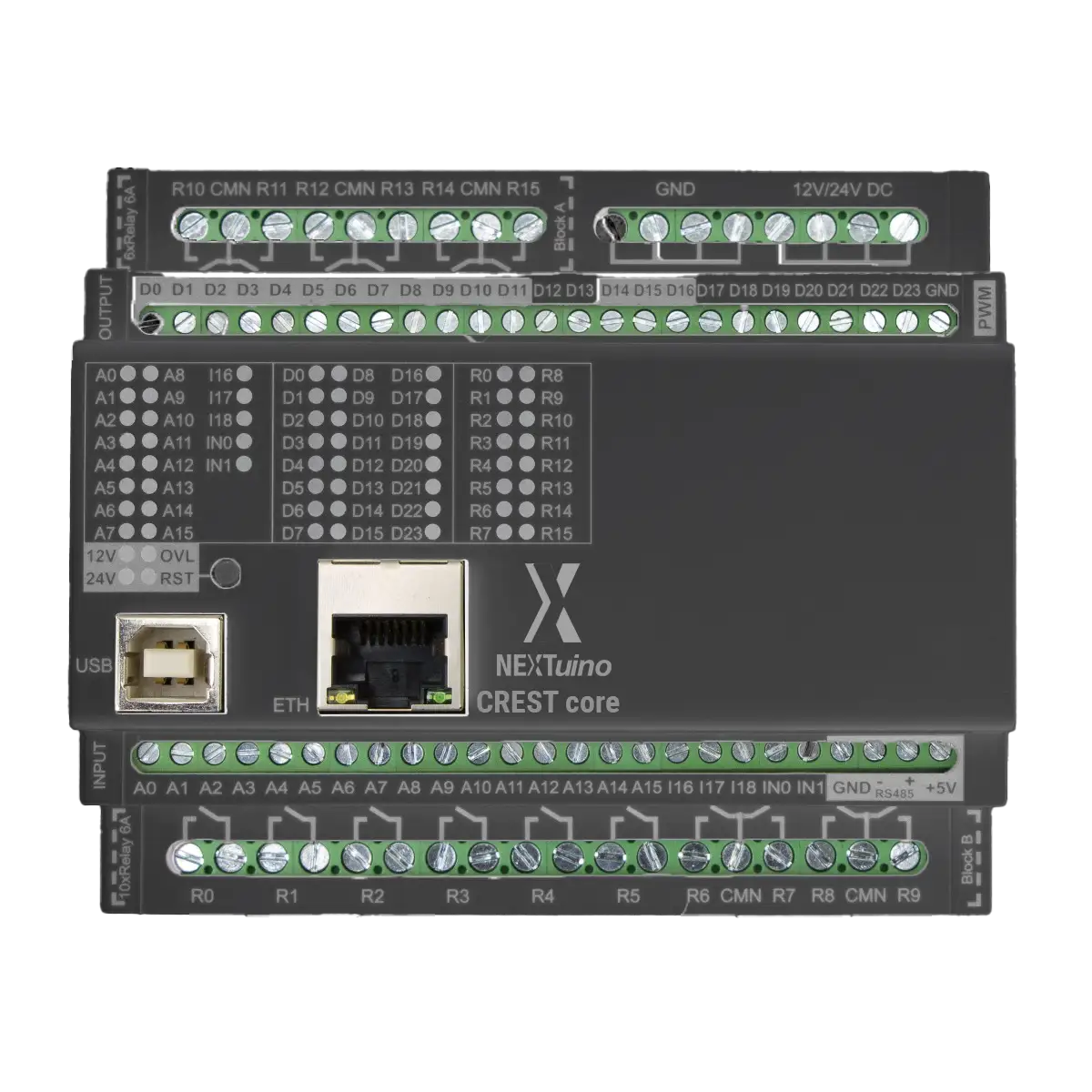
| Microcontroller | ATmega2560 @ 16 MHz |
|---|---|
| Flash / SRAM / EEPROM | 256 KB / 8 KB / 4 KB |
| Digital Inputs | 21 × protected (16 analog-capable + 5 dedicated) |
| Digital Outputs | 24 × transistor, up to 2 A each |
| Relay Outputs | 16 × relay, up to 10 A / 240 V AC |
| Analog Inputs | 16 × 10-bit ADC (shared with DI) |
| Communication | RS-485 Modbus RTU, Ethernet (W5100), UART, SPI, I²C |
| Arduino Headers | None — core variant |
| Supply Voltage | 12 V DC or 24 V DC |
| Power Consumption | < 4 W (controller only) |
| Operating Temperature | -10 °C to +55 °C |
| Dimensions (H × W × D) | 90 × 107 × 62 mm |
| Weight | ~ 370 g |
| Mounting | DIN rail (EN 60715) |
| Certification | CE |
Yes. The MCU, I/O map and peripherals are identical. Firmware written for the CREST runs on the CREST CORE without modification.
The CREST CORE omits Arduino pin headers, making the module slightly more compact and reducing BOM cost. It is the preferred option for production machine builds where shield expansion is not needed.
Yes. Both RS-485 Modbus RTU and W5100-based Ethernet are included, accessible via terminal blocks.
Yes. With 21 digital inputs, 24 digital outputs and 16 relay outputs, the CREST and CREST CORE offer the highest channel count in the NEXTuino range.
Request a sample, ask for a quote, or speak with an applications engineer.